The best B2B ecommerce platforms for 2027 are the ones that can handle your customers’ buying habits and give your team a shop they enjoy running. There is room for a handsome catalogue, a memorable brand and a pleasantly uneventful Monday morning. The trick is choosing a platform around the commercial work that actually needs to happen.
Our shortlist covers Shopify B2B, BigCommerce B2B Edition, Adobe Commerce B2B, OroCommerce, Shopware B2B Components and WooCommerce with a named B2B extension. Each deserves a different conversation. A manufacturer negotiating complex quotations and a brand launching a wholesale channel may share customers, yet need quite different operating models.
This 2027 planning guide was researched in October 2026. Documented capabilities refer to current official sources, with plan and extension boundaries identified. The recommendations are our editorial assessment of business fit, supported by practical demonstration scenarios. Historical Awwwards and Behance references show what a catalogue or a platform story can look like; they do not establish the functionality of a private buying system.
Which B2B ecommerce platform belongs on your shortlist
Begin with a description of a familiar customer. Who buys, whose prices apply, how does an order become accepted and what does the customer need afterwards? Write that journey in your own commercial language. A shortlist becomes much easier to explain when everyone can recognise the situation it is meant to improve.
| Platform configuration | A useful reason to evaluate it | Bring this question to the demonstration |
|---|---|---|
| Shopify B2B | A brand adding wholesale to an established commerce operation | Which plan supports our catalogue assignments and account requirements? |
| BigCommerce B2B Edition | A supplier shaping a company buying portal around repeat orders and quotations | How do our company hierarchy, quote and invoice tasks work in the configured edition? |
| Adobe Commerce with B2B | An organisation evaluating shared catalogues and structured company purchasing | Which B2B extension features and storefront components are included in our proposal? |
| OroCommerce | A distributor or manufacturer with substantial customer and quotation workflows | Can the configured customer model and approval flow reproduce our actual relationships? |
| Shopware with B2B Components | A commerce team seeking configurable B2B modules alongside a strong catalogue experience | Which commercial plan and components cover our employee and ordering rules? |
| WooCommerce with a named extension | A WordPress-based team with a clearly bounded wholesale process | Which extension owns each rule, and who maintains the complete installation? |
These are starting points for evaluation, rather than a universal league table. Keep two or three candidates that fit your most important journeys. Give them the same products, company structure and commercial exceptions. That makes the comparison useful to sales, finance, marketing and the people responsible for implementation.
Visual ambition belongs in that first brief. Specify what your range should communicate and how a returning customer should recognise their working space. Our best B2B ecommerce websites for 2027 offers complementary examples for the design conversation. Bring those ambitions into the platform selection while the scope is still being shaped.
Shopify B2B for brands building a wholesale channel
Shopify belongs in the conversation when a brand wants its wholesale channel to sit within a familiar commerce operation. Picture a team already maintaining products, collections and customer communication, now preparing to serve approved retailers. Its first challenge is to make wholesale relationships explicit and give staff a manageable way to look after them.
Shopify’s current B2B overview says B2B is available on all plans. It documents companies and locations, payment terms, quantity rules and volume pricing. Basic, Grow and Advanced support up to three active catalogues across B2B markets; Plus supports unlimited catalogues and direct company-location assignment. Deposits and partial payments have Plus boundaries. Customers use customer accounts, and the documented purchase-order field records a PO number.
Those boundaries give your selection workshop a very practical shape. Describe how many distinct commercial assortments you need, who receives them and how often they change. Ask the implementation team to configure representative customers rather than simply show a catalogue setting. If an important retailer requires a special assortment, record exactly how that relationship will be maintained.
Our suggested demonstration starts with a repeat buyer choosing a location, selecting a familiar range and preparing an order. Then ask a staff member to review an exception. Perhaps a customer needs assistance with an unusual quantity or an agreed delivery arrangement. Follow the task into the internal process so the people running the channel can judge whether it fits their working day.
A useful proposal also explains the role of each additional app. Ask which requirements are satisfied by the chosen plan, which use an extension and which need custom work. Give each one an owner. When a workflow spans several products, the support arrangement should be understandable to the person who will investigate an interrupted customer task.
For our editorial shortlist, Shopify is worth evaluating when the wholesale proposition is reasonably clear and the team values continuity with its wider commerce activity. More elaborate purchasing relationships need a demonstration of their exact fit. The decision should turn on your account and catalogue model, the configured buying journey and the operating responsibility your team is ready to take on.
BigCommerce B2B Edition for company buying journeys
BigCommerce B2B Edition merits attention when the customer’s company workspace is central to the project. Imagine a supplier whose buyers return to lists, requests and commercial documents throughout the week. The brief needs to describe that recurring relationship, including the work shared between the buyer and the supplier’s account team.
BigCommerce’s B2B Edition overview describes company structures, customer pricing, shopping lists, quotes, invoicing and buyer-portal options. The B2B Edition API documentation identifies it as an add-on to the BigCommerce platform. Evaluate the edition, configuration and included services named in the proposal.
Give the demonstration a company with more than one person involved in buying. Ask each person to find the work they are meant to handle and explain the information they can access. Then have the supplier’s team continue a quotation started by the buyer. A company portal earns its place when participants understand what happened and what they should do next.
Include a returning-customer task that contains an exception. A previous selection might contain an item that is no longer available or a quantity that needs changing. Ask the proposed solution to explain the current situation while helping the customer continue. This is a good moment to review the wording, the account-team handover and the relationship between a saved selection and a new order.
The portal architecture deserves its own discussion. If the proposal uses a custom storefront or buyer experience, ask who publishes changes and who checks compatibility with the underlying services. Marketing should understand how it will maintain public product stories, while operations should know how buying tasks are supported. Put both responsibilities in the same project conversation.
Our editorial reason to shortlist BigCommerce B2B Edition is a business that wants to shape a coherent company buying journey around recurring commercial tasks. Ask for a configured demonstration of your own hierarchy and quotation process. The presence of an API or a portal option becomes valuable through the completed journey your team can actually review.
Adobe Commerce B2B for structured company purchasing
Adobe Commerce with its B2B extension is worth evaluating when company purchasing rules form a substantial part of the project. Picture a business serving organisations with several buyers, a defined approval chain and negotiated ranges. In that situation, the account structure influences the catalogue, the order journey and the records people need to consult afterwards.
Adobe’s B2B documentation covers company accounts, shared catalogues, quick orders, negotiable quotes, purchase-order approvals and requisition lists. These belong to the Adobe Commerce B2B extension, which must be installed and enabled. Its documented capabilities should not be attributed to Magento Open Source. The quote documentation also describes buyer and seller activity across quote statuses.
Make your demonstration follow a purchasing decision across people. A buyer prepares a selection, an authorised colleague reviews it and the supplier follows up on the commercial request. Ask everyone to explain the state they are seeing. Write down the terms your organisation uses, then assess whether the proposed interface communicates those terms clearly.
Bring a shared catalogue that contains realistic product references, packaging and a deliberate exception. Ask who maintains its contents and who can alter a commercial condition. This gives your team a way to assess the administrative work as well as the customer-facing result. A tidy purchasing screen depends on information someone can maintain with confidence.
The storefront scope needs to be explicit. Ask the proposer to identify which interface components are included, how the B2B features are exposed and where additional implementation is required. Request the same completed customer task on the actual proposed storefront. That connects the documented backend capabilities with the experience you are commissioning.
Our editorial reason to evaluate Adobe Commerce B2B is a company purchasing model whose structure is important enough to justify a detailed implementation brief. Keep the comparison focused on the configured edition, the delivery team and the way changes will be maintained. A substantial feature set becomes a useful investment when it supports the commercial relationships your organisation actually has.
OroCommerce for customer structures and negotiated workflows
OroCommerce belongs on the shortlist when customer relationships and negotiated sales deserve a detailed model. A distributor might serve departments, branches and colleagues who share responsibility for a request. The platform conversation then begins with the structure of the commercial relationship, including the supplier staff who help the buyer complete it.
Oro’s current solution concepts distinguish customers, customer users, groups, roles, price lists, shopping lists, requests for quotation, quotes and orders. Its quote-flow documentation describes alternative workflows, including a back-office flow with approvals. Price overrides require approval when the corresponding setting is enabled. Review the released version and configured workflow in your proposal; an upcoming documentation branch is not evidence of an available feature.
Start the demonstration with a customer relationship diagram that sales can recognise. Include two branches, distinct responsibilities and one commercial exception. Ask the team to configure that structure and show what each participant sees. Continue through a request, a revised quotation and its next permitted step. The useful question is whether the relationship remains understandable throughout.
Give quotation language some proper attention. A customer should know whether they have submitted a request, received an offer or accepted a commercial proposal. Ask who can change quantities and prices at each stage, and how those changes are communicated. Review a request that needs clarification as well as the straightforward case. These exchanges are part of your service identity.
For operations, ask how a member of staff finds the current work and decides what to do. A role model should support the job rather than require people to memorise an organisational diagram. Use a typical queue of requests and invite the account team to explain which ones need attention. Their questions will often reveal the details the implementation brief still needs.
Our editorial reason to evaluate OroCommerce is a B2B project where customer structure and commercial workflows are central to the value being delivered. It deserves a demonstration with genuine complexity, a clear released-version scope and named responsibility for configuration. The brand presentation also deserves care: a specialised platform can be introduced with warmth and a visual identity people remember.
Shopware B2B Components for a configurable commerce brief
Shopware merits consideration when the team wants to build a distinctive catalogue alongside a defined set of B2B tasks. Think of a supplier with a strong visual range, several professional customer groups and a clear idea of the account work it wants to offer first. The selection can be organised around those initial tasks and the modules required to support them.
Shopware’s B2B Components documentation places the components in its commercial Evolve offering. It covers employee management, roles, order approvals, quote management, quick ordering and shopping lists, with components enabled individually. Confirm the applicable commercial plan, version and enabled components in the proposed installation.
Our suggested demonstration begins with a customer adding a colleague, preparing a familiar order and encountering an approval rule. Ask who maintains that rule and how the buyer understands its effect. Then introduce a product reference supplied in a list. Review the handling of an unknown reference or an unusual quantity so the demonstration includes the questions customers will actually bring.
Ask marketing to complete a publishing task in the same evaluation. Give the team a collection with an image, several product associations and a useful case study. Have someone publish the information and show how a visitor continues towards the range. A commerce project has both recurring buyers and prospective customers; the editorial experience deserves a concrete test.
If the proposal uses a separate product-information system or a custom frontend, specify the responsibilities at their boundaries. Choose one product change and follow it from its owner to the customer’s screen. Ask what happens when the information is incomplete. That provides a much more useful conversation than a diagram full of connected boxes.
Our editorial reason to shortlist Shopware is a project whose B2B tasks can be described as a deliberate set of components, with a catalogue experience the business wants to develop carefully. Evaluate the named commercial configuration and the team that will maintain it. The Borek reference below brings some welcome visual confidence to that catalogue discussion.
Give the platform a catalogue people want to explore
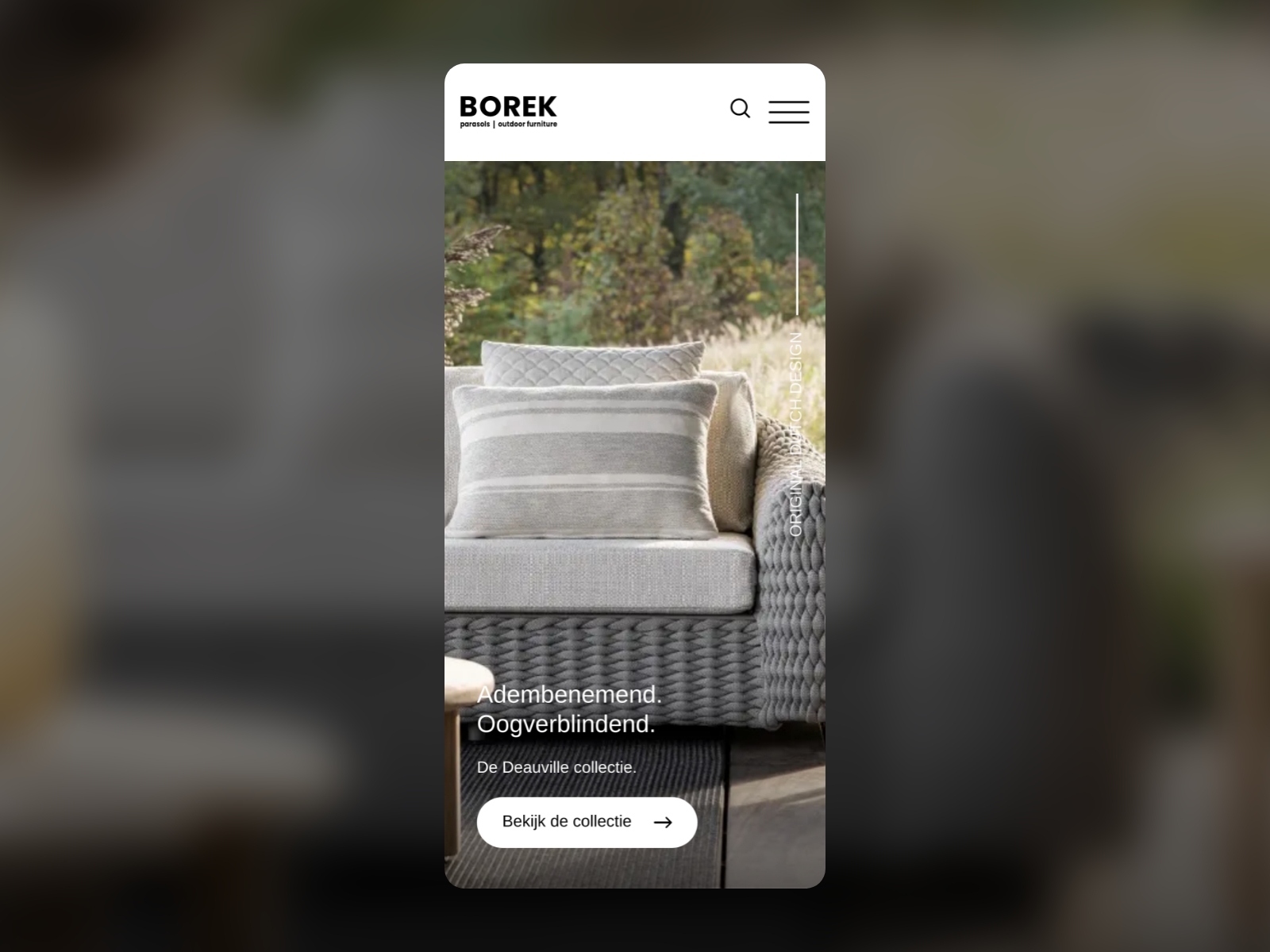
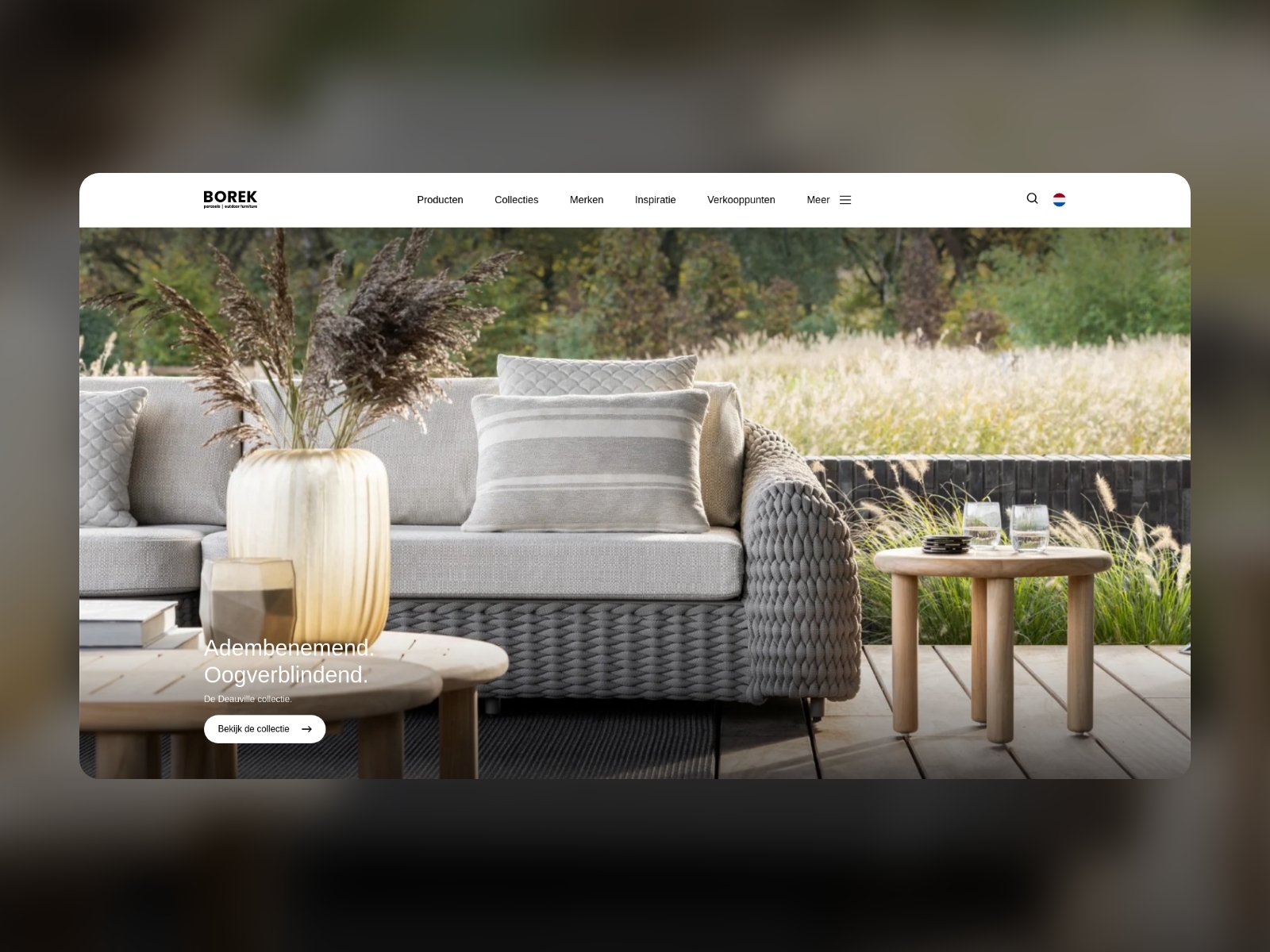
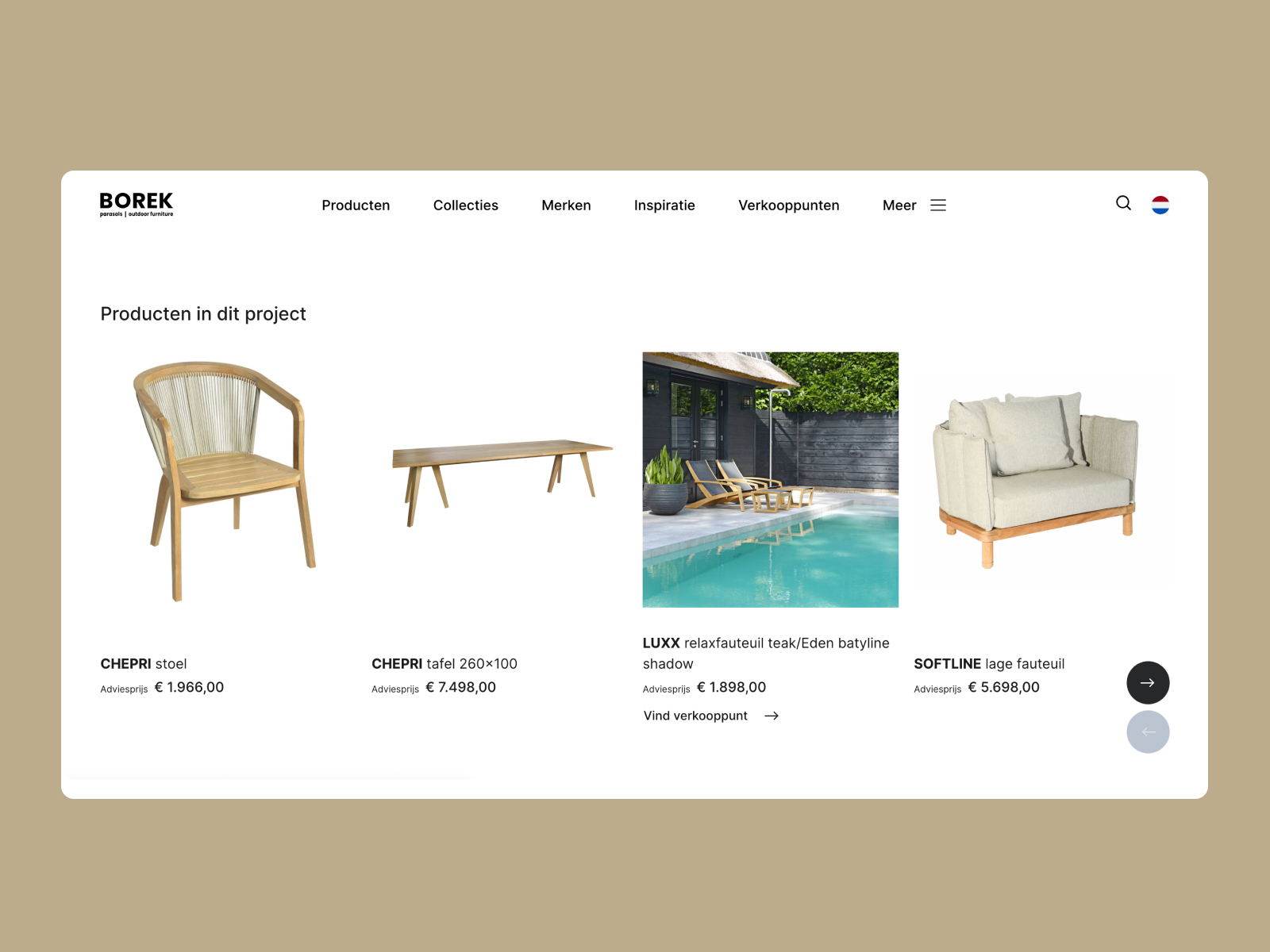
Borek’s 2024 presentation by NOBEARS is a public furniture catalogue and dealer-discovery reference. Awwwards lists it as a nominee; its Products element carries Shopware, headless and Akeneo tags. We use these historical visuals to discuss presentation, while platform capabilities are checked against current official documentation.
That garden photograph does quite a lot of work. Woven surfaces, generous cushions and a clear collection invitation make the range feel tangible. In a platform brief, ask how public collection storytelling will connect with the product information your professional customers need to investigate.

The mobile composition gives search and the menu a clean white home, then lets the narrower photograph keep its texture. The collection button stays distinct. Use this view to brief the first mobile task: recognising the range and choosing a useful way into it.
Here the desktop header sits in its own white bar. It gives navigation a stable contrast while the wide hero supplies atmosphere. When comparing platform themes or bespoke proposals, ask the team to show how that balance survives different collections and photographic backgrounds.
The product cards mix clean cutouts with a photograph of the furniture in use. Names and recommended retail prices keep a consistent place. The visible dealer route is useful context: define separately how your own public assortment, approved customer access and negotiated commercial information should connect.
The project page places a real installation beside a compact information card. That connection gives a prospective buyer a reason to explore the range further. Include a case-study publishing task in the platform demonstration, with the products and project information your marketing team will maintain.

WooCommerce with a named B2B extension for a bounded wholesale process
WooCommerce is worth evaluating when the team already works comfortably in WordPress and can describe its wholesale requirements precisely. A specialist supplier might need approved registrations, clear customer groups and a manageable catalogue, with an editorial site supporting the commercial proposition. The important decision is the complete configuration that will deliver those requirements.
For a concrete example, the B2B for WooCommerce extension documentation describes registration, user roles, catalogue visibility, quote requests, role-based pricing and restrictions on shipping, payment and orders. These are features of that named extension. Other B2B products have their own scope; they should be evaluated separately rather than combined into an imaginary standard WooCommerce feature set.
Write down which component owns each rule in the proposed installation. A wholesale price, customer registration and quote request should each have an identifiable home. Then ask a member of your team to maintain a small customer group and a representative product range. The administrative demonstration will tell you whether the arrangement fits the people who will look after it.
Give the proposal an update and support scenario. Ask how a change to the store or extension will be checked before release, how interrupted buying tasks are investigated and who coordinates a problem involving several components. A clearly bounded wholesale process still needs an operating owner. Include that work in the project scope from the beginning.
Review company purchasing requirements individually. If your brief needs several buyers under one company, location-specific rules or an internal approval chain, request those exact journeys. A registration role alone does not answer every organisational question. The demonstration should identify any additional extension or custom work needed and make its maintenance responsibility clear.
Our editorial reason to shortlist WooCommerce is a business with a defined wholesale process, an existing WordPress capability and a delivery partner who can explain the complete installation. Ask for the actual combination of components to be demonstrated together. Your decision should include the customer experience, editorial work and ongoing care of the configuration.
Give every platform the same useful demonstration
A good platform demonstration tells a small story your team recognises. Prepare two customer companies, a few colleagues, a representative assortment and one exception. Use fictional personal and commercial data that still reproduces the structure of your real work. Give each candidate the same scenario and ask the people who will run the channel to participate.
Show whose commercial conditions apply
Ask a buyer to enter the correct company or location and identify the range they are allowed to purchase. Have them select products with different selling units. Then change the purchasing context and review what happens to the work in progress. The result should be understandable to the customer and traceable by the person managing the account.
Let a request move between people
Prepare a request that needs one clarification and a revised offer. Ask the buyer and supplier to continue it in turn. If approval is part of the brief, include the authorised reviewer and an action another participant is not permitted to complete. Record the expected outcome before the demonstration, including the message each person receives.
Follow one order into the ERP
Choose a representative order and identify the system responsible for each important piece of information. Follow the order reference, customer association, quantities and acknowledgement through the proposed connection. Then introduce a delayed response. Ask how the customer and support team know what has happened, and how a retry avoids creating an unintended second order.
Review a product change and a mobile task
Give the catalogue owner a change to a product description or document, then inspect the customer result. Ask a buyer on a narrow screen to find a familiar item and return to an existing request. These tasks connect content maintenance with the everyday experience of the site. Your 2027 B2B ecommerce roadmap can use the findings to choose which improvements deserve the first release.
Keep a simple record of completed tasks, unresolved questions and the component responsible for each requirement. Invite the supplier to explain any configuration needed to finish the scenario. This makes the final comparison concrete and gives the selected delivery team a useful starting point for implementation.
A real OroCommerce design story that makes B2B easier to explain
Software selection also involves explaining the decision to people who will live with it. The Unicorn’s OroCommerce illustration and motion project provides a lively example. Published on Behance in June 2022 and extended with a 2023 podcast update, it gives buyers, conversations and business systems a shared visual language. These are historical brand illustrations and animations. The current platform comparison above comes from the separate vendor documentation linked in each section.
Start with the people who need to buy

Four people use different tools within the same landscape. That is a helpful starting point for a platform brief: the occasional purchaser, procurement manager, branch buyer and account representative need different actions, while still belonging to one coherent experience.

The teal and warm accents make this early study unusually colourful. Looking at it beside the later versions helps separate visual preference from function. A lively palette can support a memorable brand, but the contract price still needs an unmistakable label.

Here the surrounding shapes become lighter and the person takes priority. The composition offers a useful lesson for complex buying pages: a quieter background gives the important action room to stand out, especially when the page already contains dense specifications.

This version uses fewer competing colours without losing character. In a portal, that kind of restraint can create a consistent place for emphasis. The lesson is visual hierarchy: make the selected company, price or next action easy to identify.
Give the business case a clear hierarchy

A white ROI card, gear and profile figure put the business topic into a recognisable scene. For a selection workshop, keep that clarity but supply your own numbers: implementation cost, operating effort and the tasks the new channel should improve.

The dark card becomes the anchor while the small symbols carry supporting meaning. A procurement document benefits from a similar order. Put the decision and its evidence first, then make assumptions and dependencies easy to inspect. Decorative financial symbols cannot supply those assumptions.

The small yellow details work harder because most of the scene is neutral. This is a good reference for highlighting one meaningful comparison point. In your actual evaluation, that might be the cost of an approval module or the responsibility for supporting an ERP connection.
Explore personality without losing continuity

Grain and warm colours give this study a tactile feel. The character still holds the familiar quarter shape, so the story remains recognisable. A commerce brand can have this much personality while keeping purchasing controls calm, legible and consistent.

The changed palette produces a different atmosphere with the same gesture and geometry. That distinction matters when comparing platform demos: a theme can change the appearance substantially. Test the underlying account and order behaviour before deciding that one attractive treatment means a better operational fit.

This darker treatment concentrates attention on the object in the person’s hand. It makes the repeated visual vocabulary easy to see across otherwise different studies. For your own project, document a similarly small set of components that can survive catalogue, quote and account pages.

The storyboard connects people, conversations, system labels and an eventual agreement. Bring that sequence into a vendor workshop. A useful demonstration follows a complete buying situation, including an exception, instead of moving between unrelated feature screens that never meet in one order.
Let movement connect the explanation

The quarter-circle lens becomes part of a broader transition as the figure changes and returns. One recurring ingredient links the movement together. That is an effective storytelling device for introducing a complicated subject before a reader reaches the more detailed explanation.

The four gestures stay distinct without breaking the shared identity. It is an engaging way to suggest that people work differently. Use that thought in your requirements: the representative preparing a quote and the buyer replenishing stock should each have a clear route.

The second person and speech bubbles turn an isolated scene into a relationship. That human emphasis suits B2B commerce, where a buying task can move between customer and account team. Your software demo should show who receives the request and who can act next.

The expanding rings turn a small group of shapes into a larger picture. The visual is a useful introduction to connected parts, while an integration plan needs the detail underneath: which system owns each value, how changes travel and how failures are handled.

A reaching gesture becomes a thinking pose, then a changed orientation before the scene returns. The animation gives an abstract decision some personality. A platform selection benefits from an equally clear pause to examine the exceptions that an ideal demo can easily glide past.
The full film moves through character scenes, the OroCommerce identity, commercial conversation and labelled business systems before closing on the brand. The repeated shapes make those changes feel connected. Ask for equally connected demonstrations when comparing software, with actual data and recorded acceptance criteria.
Keep the same identity when the conversation broadens

The small sailboat gives this scene a simple focal point and a sense of exploration. It takes the visual identity into a different conversation without replacing all its ingredients. That continuity is useful when your own brand moves from product pages into educational resources.

The hands frame a small object with generous surrounding space. Even a compact illustration can carry the subject clearly. In an actual buyer journey, that same discipline helps a page explain one task at a time rather than crowding every account feature into its opening view.

The sequence changes scale and moves the boat into water before returning to its opening. The metaphor stays understandable through those transitions. For your own communication, choose a few recognisable subjects and develop them, instead of adding unrelated stock graphics to every section.

An individual speaker gives way to a connected group of people. The change makes the community idea visible without much text. The surrounding stars are illustrative elements; a serious platform comparison still needs its own evidence, including references from businesses with comparable buying complexity.

The laptop, invitation label and speaker frame establish a path into a conversation. This is useful inspiration for introducing a learning resource. For your commercial portal, explain the real next step with equal clarity: request access, ask for a quote or place an authorised order.

The hanging star is singled out before the composition recedes and returns. One object provides the point of attention. In a vendor presentation, decide what earns that attention using your acceptance criteria, rather than allowing an attractive badge or rating graphic to make the decision.
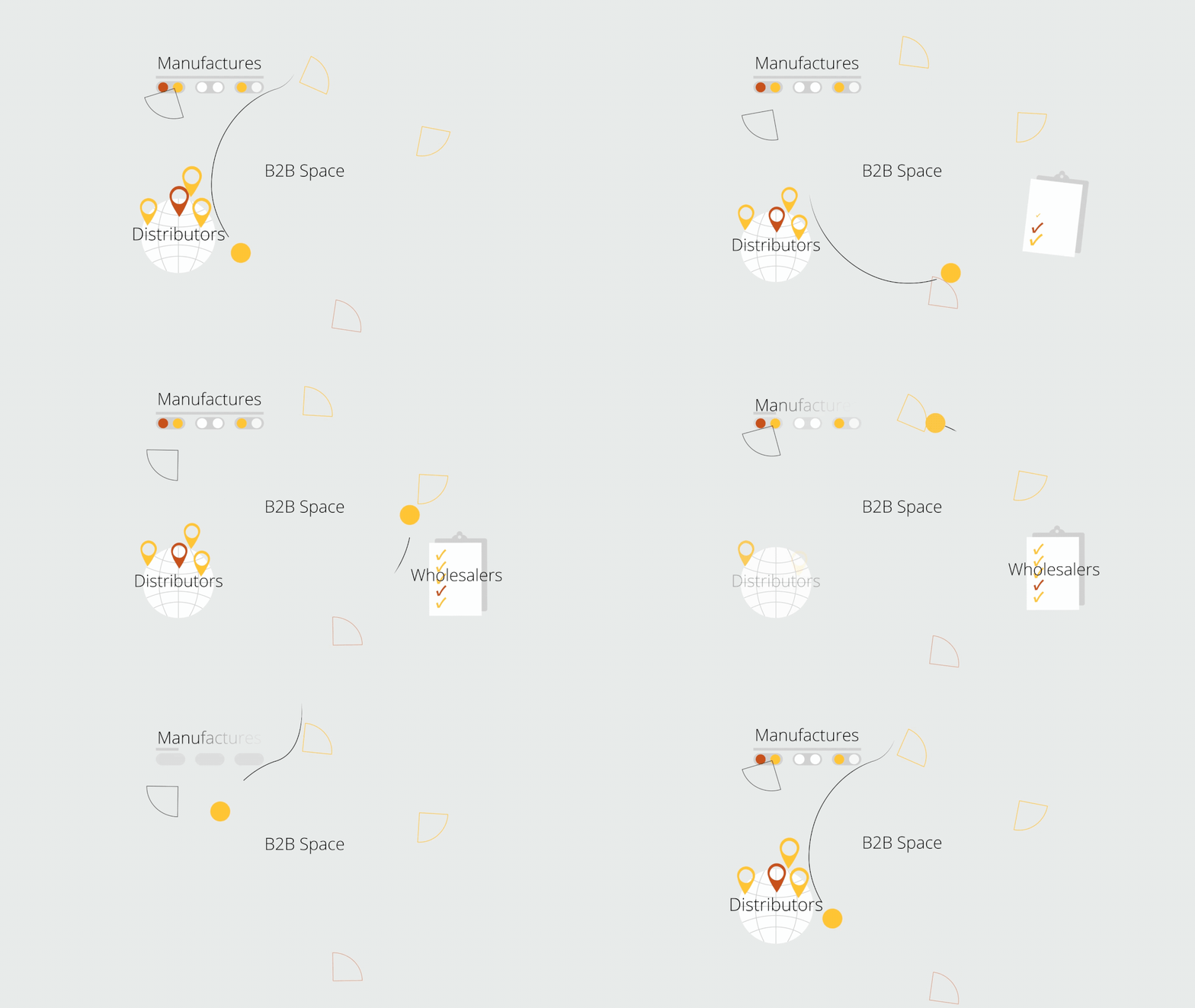
Manufacturers, distributors and wholesalers appear around the B2B subject with recognisable symbols. Naming the audience makes the explanation more concrete. Do the same in your brief: describe the actual company structures and buying rules that the chosen platform will need to support.

A compact set of line icons frames the B2B ecommerce label. Their common style keeps the topic together as the pieces move. Treat icons as navigation aids in your own project, then use explicit labels and explanations where buyers need to understand a commercial commitment.
The podcast introduction carries the boat, circles, quarters and character system into a community story, then closes with an overhead parcel composition. Its visual continuity is the useful lesson. Scheduling statements inside the historical film belong to its original publication period.

The familiar colours and small shapes let this new pose belong to the same family immediately. That is a strong argument for consistent design components. A buyer moving between a catalogue, saved list and account page should recognise the same vocabulary without relearning the controls.

The pieces spread out, regroup and support a white megaphone. The scene develops an existing vocabulary around communication. It is a useful reminder that an established identity can evolve: your 2027 portal can improve its explanation while keeping familiar entry points for returning buyers.
The update adds tiled business symbols, speaker panels and an illustrated host before returning to the parcel-based closing identity. The creative system accommodates a changed introduction without losing continuity. The host’s experience and scheduling wording remain statements from that historical film.
The credit board makes the collaboration behind the work visible. A successful commerce project also needs named responsibility: product, design, data, development, sales operations and ongoing support. Make those responsibilities part of your platform decision, so ownership stays clear after the launch meeting.
Choose the platform around your first useful release
Bring the evidence back to the original customer journey. Which candidate can deliver it in the proposed configuration, and which team has explained the operating responsibilities clearly? Review the customer experience alongside the daily work of the catalogue owner, account team and support staff. Each group should understand what it will be able to do.
Ask for a complete project scope covering the selected plan or edition, extensions, design, migration, integration, hosting where applicable and ongoing support. Identify any recurring services and the work required when your commercial rules change. A comparable scope helps you judge proposals with different approaches to delivering the same business outcome.
Plan a first release that gives a defined group of customers a complete useful journey. It might let approved buyers browse their range, prepare a request and continue it with the account team. Agree how you will recognise a completed task and gather customer feedback. That produces a practical basis for extending the channel after launch.
Give the visual system an equally clear brief. Choose the product story customers should recognise, the information they need to compare and the account language that helps them continue their work. The references in this article show how much character can fit around those purposes. A platform decision and a design decision become more valuable when they support the same relationship.
At Code B2B Commerce, we can help turn that shortlist into a commerce brief with customer journeys, catalogue structure and integration responsibilities your team can review. Bring your current way of selling, a representative range and the questions customers ask most often. Those details give the 2027 project a useful place to begin.
Frequently asked questions about B2B ecommerce platforms in 2027
Which is the best B2B ecommerce platform for 2027
Start with the platform that fits your company structure, catalogue assignments and way of accepting orders. Our shortlist covers six configurations with different reasons to evaluate them. Give the strongest candidates the same buying and operating tasks, then compare the completed journeys and the proposed support responsibilities.
Is Shopify B2B limited to Shopify Plus
Shopify’s current documentation says B2B is available on all plans, with important differences in catalogue assignment and some payment features. Check the chosen plan against your company and catalogue model. Use the official plan comparison during selection and ask for your requirements to be configured in the demonstration.
Can WooCommerce support B2B ecommerce
A WooCommerce installation can use a named B2B extension to support a defined wholesale process. Identify the extension that supplies each requirement and review the complete configuration together. Include registration, pricing, quote requests, any company purchasing rules and the responsibility for updates and support in the evaluation.
Should a B2B ecommerce platform connect to the ERP
Decide which information your buying journey needs from the ERP and which system owns it. Demonstrate a representative order, its acknowledgement and a delayed response. The proposed connection should explain what the customer sees, how staff investigate an exception and how the order reference remains consistent across systems.
How should we compare platform proposals
Give each candidate the same customer structure, product range and commercial exception. Record which tasks are complete, which need additional configuration and who owns each component. Compare the full delivery and operating scope, then choose a first release that gives a defined customer group a complete useful journey.